Compass app - Accurate Compass
- 3.6
- Rating
- 1.00M
- Installs
- Free
- Price
 Analysis by App-foxy
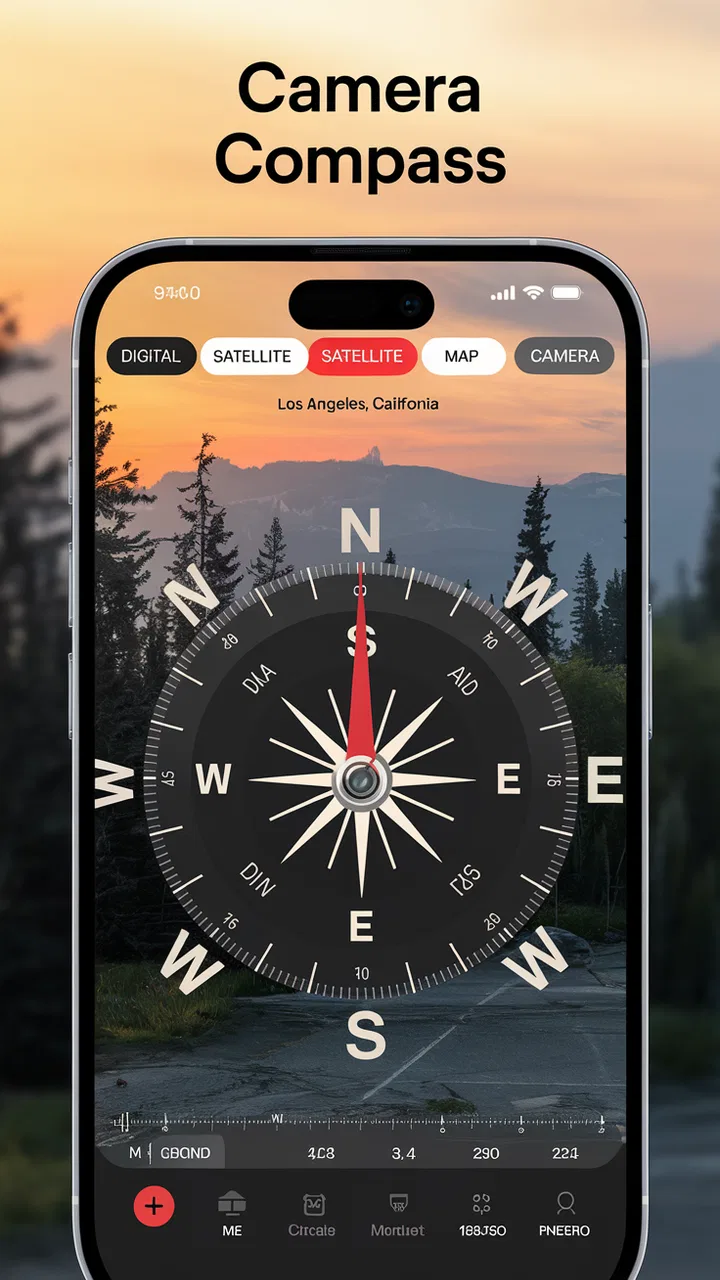
I usually keep a compass app for the moments when a map feels like too much information. When I only need to know which way I am facing, a focused tool is quicker than opening a full navigation service. Compass app - Accurate Compass takes that simple approach. It belongs to the Maps & Navigation category, is free to use, and is aimed at giving you a direct directional reference rather than turning your phone into a complete trip planner.
After spending time with it, my impression is straightforward: this is best understood as a lightweight orientation tool. It can be useful before a walk, while checking a trail direction, or when you are trying to match a paper map with the landscape around you. It is not the kind of app I would choose for turn-by-turn driving, route planning, traffic information, or saved travel itineraries. Its value comes from doing one small job without surrounding that job with unnecessary screens.
The app is made by Photo and video apps, which is an unusual developer name for a navigation utility, but the important point in daily use is how simple the product feels. It has a 3.6 average from around 775 ratings and has passed 1M+ installs, so it has clearly attracted a sizeable audience despite being a narrowly focused tool. It is free and rated for Everyone, making it approachable for casual users and families who want a basic directional aid.
You May Also Like

 Blood Strike: 2.5 Anniversary
Blood Strike’s Loadouts Turn Every Drop Into a Tactical Gamble
A close look at Blood Strike’s custom loadouts: how fast access to signature weapons reshapes its battle royale rhythm, rewards preparation, and narrows the gap between fights.

 Pandora - Music & Podcasts
Pandora’s Music Is Easy to Start, but Harder to Recover
Pandora’s strength is its low-effort path from a seed to a station. Its weak spot is how much confidence it asks you to place in connection, setup, and quiet recovery.

 8 Ball Pool
 Is Built on Rivalries, Rematches, and Routine
A close look at the rivalries, rematches, shared routines, and unanswered safety questions that turn a quick pool match into a persistent mobile community.

 Samsung Music
’s Quiet Strength Is Playing What You Already Own
Its reach comes less from spectacle than from dependable access to a personal library. That simplicity is both the app’s strongest retention engine and its ceiling.

 AccuWeather: Weather Radar
AccuWeather Review: A Quick, Clear Forecast for Everyday Decisions
For everyday plans, the best forecast is the one you can understand quickly. AccuWeather makes rain timing, radar, and local conditions easy to act on, with a few trade-offs.

 Hill Climb Racing
Why Hill Climb Racing Still Turns Crashes Into One More Run
A tiny car, a bumpy hill and one more upgrade: Hill Climb Racing keeps resurfacing because its simple chaos makes every near-miss feel personal.
More From Our News Desk



Getting oriented before the first real use
Before relying on a phone compass outdoors, I like to learn what a steady reading looks like in a familiar place. That quick check gives me a baseline for noticing when my surroundings or the way I’m holding the phone may be affecting the result. It also makes the first real use less about guessing and more about applying a simple reference with care.
What to expect from the experience
The first thing I would tell a new user is not to expect a miniature version of a full map service. The store summary presents it as a way to begin an adventure with confidence, but the practical experience is more modest and more specific: you open it when you want a compass reading, look at the direction shown, and use that information alongside your surroundings.
That narrow purpose is actually helpful. Full navigation apps often ask you to enter a destination, choose a route, wait for map content, and interpret several layers of information. A compass removes those steps. If I am standing outside a station and want to know which way is north before deciding where to walk, a dedicated compass is more immediate than searching for a destination.
At the same time, simplicity creates a clear trade-off. A compass cannot tell me whether a road is closed, which footpath is safest, how long a route will take, or whether I am following the correct street. It gives direction, not context. I treat it as one instrument in a broader process rather than as a replacement for maps or local signs.
The app is compatible with devices running Android 6.0 or later, which covers many older phones as well as newer models. Its current version is 1.0.6. That makes it worth checking your device before installing, especially if you are using an older handset kept for outdoor trips. On a supported phone, the low-complexity design is likely to be more important than having the newest hardware.
Installing and preparing for the first check
Because the app is free, there is no purchase decision to make before trying it. I would install it before leaving home rather than waiting until I am already lost or standing at a trail entrance. A compass is most useful when I have enough time to understand what the screen is showing and compare it with something familiar, such as the direction of a street or the position of the sun.
My preferred first setup is simple. I open the app in a place where I know the rough direction of north, hold the phone flat, and rotate slowly. I then compare the displayed orientation with a map or a known landmark. This is not about chasing perfect precision; it is about learning how the device responds in my hands. If the reading seems to move unpredictably, I repeat the check while keeping the phone level and away from objects that might interfere with its sensors.
This is one of the most important practical habits with any phone compass: do not judge it while waving the device around. A compass is sensitive to how the handset is held, and a quick turn can make the result harder to interpret. I get a more useful reading when I pause, keep the phone steady, and allow the direction indicator to settle before acting on it.
I also recommend testing the app in the environment where you plan to use it. A reading taken indoors, beside metal furniture or electronic equipment, may not behave like a reading in an open park. That does not automatically mean the application is broken. It means the phone’s sensing hardware and surroundings both matter, so a calm outdoor check is a better starting point.
Reaching the first meaningful success
For a first-time user, the first successful action should be deliberately small: identify north, turn toward it, and then use that reference to orient yourself toward a visible landmark. For example, I might stand at the entrance of a large park, confirm which side is north, and decide that the lake lies generally east. Once the screen and the real landscape agree, the app has already done its main job.
A realistic everyday situation is finding a meeting point in an unfamiliar public space. Suppose I leave a subway exit and receive a message telling me to walk toward the north side of a square. I do not need a full route to begin. I can open the compass, establish north, and choose the correct side of the square before switching back to ordinary street signs. That saves time when the destination is nearby but the surrounding buildings make orientation confusing.
Another useful workflow is pairing the compass with a printed hiking map. I can first orient the map so its north line matches the direction shown on the phone. After that, trails and landmarks become easier to compare with what I see around me. The app does not replace the map; it helps me hold the map in the right relationship to the terrain. This is a more dependable use than trying to follow a direction blindly for a long distance.
For a better result, I avoid making a decision from a single glance. I pause, read the direction, turn slightly, and check whether the indicator changes in a consistent way. If I am walking, I confirm again after reaching a recognizable point such as a corner, sign, bridge, or gate. This turns the compass into a series of small checks rather than a false promise that one reading can guide an entire journey.
Confusion that can happen during use
The most common confusion is assuming that a compass knows where you should go. It does not. If I point toward north, that may lead across a building, into a restricted area, or away from the road I actually need. The app can tell me orientation, but I still have to interpret the environment and choose a safe, accessible path.
Another source of uncertainty is movement. When I rotate quickly, the display may be difficult to read, especially if I am also trying to watch traffic or carry other items. I get better results by stopping for a moment and holding the phone in a consistent position. This small pause is easy to overlook, yet it makes the difference between a useful reference and a confusing stream of changing directions.
It is also important not to treat the compass as a substitute for safety preparation. On a longer walk, I would still carry a map, keep my phone charged, and tell someone where I am going. A compass app is convenient precisely because it is on the phone, but that convenience can encourage overconfidence. If the trip depends on reliable navigation, I prefer using it with a proper map or a more complete navigation app.
Some users may also find the focused nature limiting. If I want nearby businesses, public transport information, route alternatives, or spoken guidance, this is not the right tool. A map application is better when the question is “how do I reach this address?” This compass is better when the question is “which way am I facing?” Choosing between the two becomes easy once I separate those needs.
Practical ways to get more from a simple compass
One non-obvious advantage of a dedicated compass is that it can reduce decision fatigue. When I am in a large building complex or open recreation area, I do not always need a detailed map immediately. Establishing one fixed direction gives me a stable reference for the next choice. I can then use signs, landmarks, and local information without repeatedly losing track of my orientation.
A second useful technique is to use the app before starting, not only after becoming uncertain. I can check the direction of a trailhead, the side of a campsite facing a road, or the orientation of a balcony before moving. That initial reference helps me notice when I have turned around later. It is particularly useful in places where paths look similar and visual memory is unreliable.
A third trade-off involves convenience versus confidence. The app is quick to open and focused enough for a short check, but its reading should not become the only evidence behind a serious decision. I use it to confirm an observation, not to override obvious signs such as a marked trail, a local warning, or a blocked route. In other words, the strongest workflow combines the compass with human judgment rather than treating the screen as an authority.
I would also make a habit of checking the direction from more than one position when the result matters. If I am trying to align a map, I move a short distance away from a large metal object and compare the reading again. Consistency is more reassuring than a single impressive-looking number or direction. This is a practical test that costs little time and helps separate a stable reading from an environmental problem.
Who should use it and who should choose something else
I think this app suits people who want a quick, uncomplicated orientation aid. It is a reasonable choice for casual walkers, travelers who carry paper maps, students learning basic map reading, and anyone who occasionally needs to identify north without installing a feature-heavy navigation package. The Everyone age rating and free access also make it easy to try without committing money or setting up a complicated service.
I would be more cautious about recommending it as the only navigation tool for remote hiking, boating, emergency situations, or unfamiliar cities. Those situations demand more than a directional indicator. Offline maps, route records, location sharing, elevation information, or detailed landmarks may matter more than a clean compass screen. In those cases, I would choose a full navigation solution and keep a physical backup where appropriate.
It is also not ideal for someone who mainly wants driving directions. Opening a compass to travel across town adds an unnecessary interpretation step when a route planner can show roads, turns, and arrival information. The app earns its place when direction itself is the problem, not when the user needs a complete answer about distance and travel time.
My next step after the first successful check
Once I have confirmed that the direction changes sensibly as I turn, I use the app as a supporting habit rather than staring at it continuously. I check my heading at the start of a walk, after a major change in direction, and whenever the surrounding landmarks stop making sense. This keeps the tool useful without letting it distract me from the path, traffic, or people around me.
If I were preparing for a day outdoors, I would combine the compass with a downloaded or printed route plan, a charged phone, and a clear meeting point. The compass can help orient the plan, but the plan supplies the information the compass cannot. That combination is more resilient than relying on any single screen.
My overall view is favorable within those boundaries. Compass app - Accurate Compass is not ambitious, and that is its main strength. It offers a free, direct way to check orientation on supported Android devices, with enough reach to have attracted over a million installs. The average rating of 3.6 suggests that expectations may vary, so I would approach it as a basic utility rather than a precision navigation system.
For me, the deciding question is simple: do I need to know a direction, or do I need a route? If I need a direction, this app is a convenient first step. I would install it before a walk, test it calmly in a familiar place, and use it alongside signs and maps. If I need complete navigation, I would choose a different category of app. Used for the job it is designed to handle, it can turn a moment of uncertainty into a clear next move without making the process feel complicated.
FAQs for Compass app - Accurate Compass
01What is the primary function of the Accurate Compass app?
The Accurate Compass app is designed to provide users with precise directional guidance using the built-in sensors of their smartphone. It serves as a digital compass, offering accurate readings to help users navigate easily whether they are hiking, traveling, or just exploring their surroundings.
02Does the Accurate Compass app require an internet connection to function?
No, the Accurate Compass app does not require an internet connection to function. It relies on the smartphone’s internal sensors, such as the magnetometer, to provide directional readings. However, some additional features, like map integration, may require internet connectivity.
03How accurate is the Accurate Compass app compared to a traditional compass?
The accuracy of the Accurate Compass app is generally very high, depending on the quality of your device’s sensors. Regular calibration of the app is recommended to maintain precision. Factors such as magnetic interference from nearby electronics can affect readings, so it's best used away from such interference.
04Is the Accurate Compass app compatible with all smartphones?
The Accurate Compass app is compatible with most modern Android and iOS devices that have the necessary sensors, such as a magnetometer. However, compatibility can vary based on the specific model and software version of the device. It’s advisable to check your device’s specifications before downloading.
05Are there any costs associated with using the Accurate Compass app?
The Accurate Compass app is typically free to download and use. However, there might be optional in-app purchases or advertisements within the app. Users should review the app’s listing on their respective app store for specific details about any potential costs.
Pros
- Highly accurate directional readings.
- Easy-to-use interface for all users.
- Lightweight
- doesn't drain battery.
- Useful for hiking and navigation.
- Works offline without internet.
Cons
- Ads can be intrusive at times.
- Limited features in free version.
- No customization options available.
- Requires calibration frequently.
- Not suitable for advanced navigation.

Compass app - Accurate Compass
Gallery